
1. Chemical Composition & Clinker Proportions
The performance differences between cement types originate in their raw material formulations and chemical clinker-to-additive ratios defined under Ethiopian Standard ES 1177-1:
- Ordinary Portland Cement (OPC 42.5R): Formulated with 95% to 100% pure Portland clinker and 0% to 5% gypsum regulator. The high concentration of Tricalcium Silicate (C3S) drives rapid hydration, releasing intensive early chemical heat and producing rapid compressive strength accumulation within the initial 48 to 72 hours.
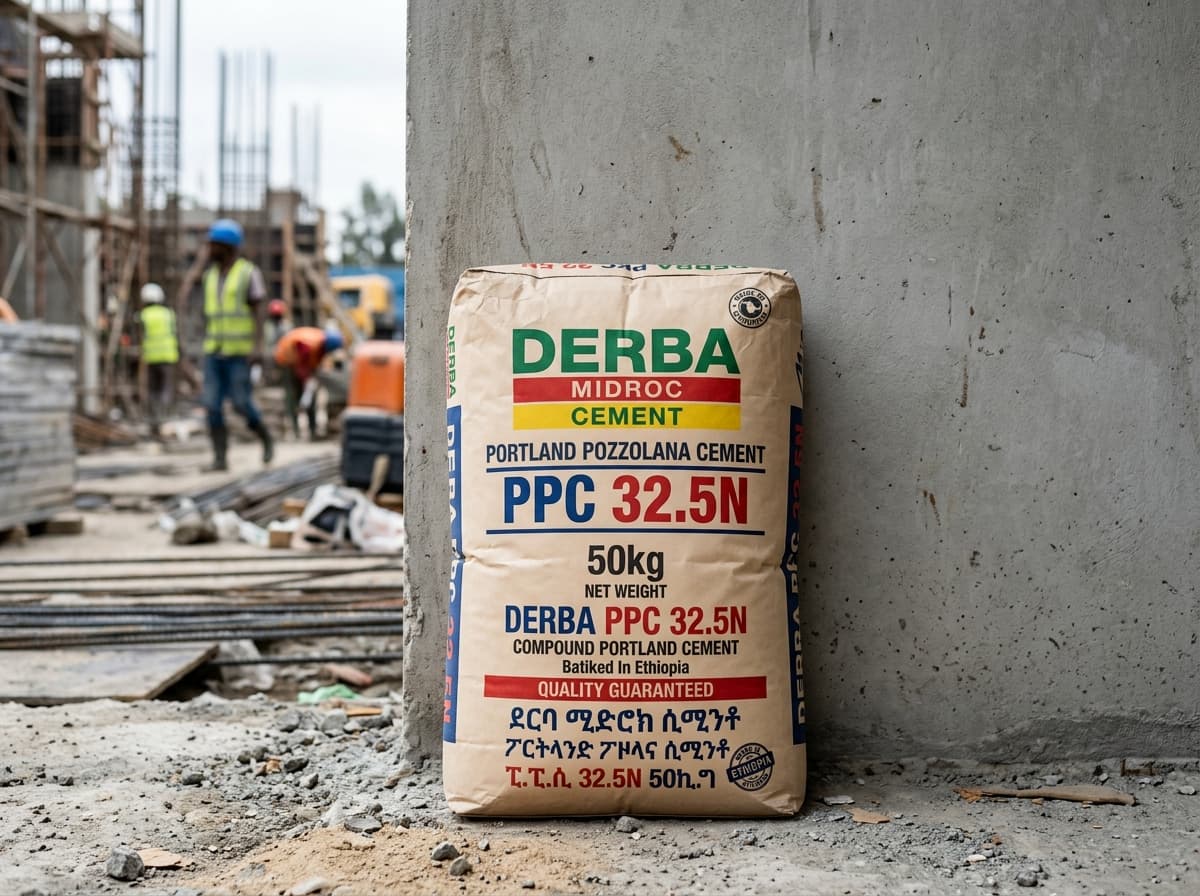
- Portland Pozzolana Cement (PPC 32.5N): Blends 65% to 75% clinker with 25% to 35% natural volcanic pozzolana (pumice and volcanic ash quarried abundantly along the Ethiopian Rift System). The secondary pozzolanic reaction consumes calcium hydroxide (Ca(OH)2) by-products, converting them into resilient Calcium Silicate Hydrate (C-S-H) gel structures over a prolonged 90-day hydration trajectory.
2. Compressive Strength Development Curves & Formwork Stripping
Formwork cycle efficiency is directly tied to cement strength development. When casting suspended structural elements in high-rise buildings, stripping cycles dictate site profitability and cash-flow velocity:
| Property / Timeline | OPC 42.5R (Rapid Hardening) | PPC 32.5N (Standard Pozzolanic) |
|---|---|---|
| 2-Day Compressive Strength | ≥ 20.0 MPa (High early yield) | ≥ 10.0 MPa (Moderate early yield) |
| 7-Day Compressive Strength | ≥ 32.0 MPa (Stripping threshold) | ≥ 18.0 MPa (Gradual hydration) |
| 28-Day Target Strength | ≥ 42.5 MPa to 52 MPa | ≥ 32.5 MPa to 40 MPa |
| Beam Soffit Stripping Time | 14 days (under approved curing) | 21 to 28 days mandatory |
| Heat of Hydration | High (~350 kJ/kg) | Low to Moderate (~240 kJ/kg) |
3. Where to Specify OPC 42.5R: High-Stress Applications
OPC 42.5R should be specified for structural elements subjected to high mechanical loads, seismic forces, or accelerated production timelines:
- Heavily Loaded Columns & Core Shear Walls: High early compressive resistance allows vertical column forms to be struck within 24 hours, maintaining rapid multi-story construction cycles without column creep.
- Precast Prestressed Girders & Bridge Decks: Facilitates early prestress tendon transfer without concrete creep or excessive slip deformation.
- Cold-Weather Concreting: The elevated exothermic hydration heat safeguards fresh concrete against thermal retardation during cold overnight temperatures in highland areas like Addis Ababa and Entoto.
4. Where PPC 32.5N Outperforms OPC: Long-Term Durability & Mass Concrete
Despite lower early strength, PPC 32.5N possesses distinct chemical and physical advantages that make it superior for specific architectural scenarios:
- Low Thermal Cracking in Mass Foundations: When pouring thick raft foundations exceeding 1.0m depth, the lower heat of hydration prevents severe core-to-surface thermal gradients that induce destructive micro-fissuring.
- Impermeability & Chemical Resistance: The pore refinement resulting from the pozzolanic C-S-H reaction blocks capillary suction pathways, rendering concrete highly resistant to sulfate attack from damp groundwater and acidic black cotton soils.
- Workability in Masonry Plastering & Screeds: Pozzolanic micro-particles enhance mortar cohesiveness, preventing segregation and providing a buttery, crack-free finish on masonry block walls.
5. Site Quality Checklist Before Authorizing Pouring
Regardless of whether OPC or PPC is deployed on your project, ensure these three field tests are performed by your resident supervision engineer:
- Slump Cone Test: Verify workability on site before discharging mixer chutes. Target slump for pumped concrete is 120mm to 160mm. Never allow site workers to add unmetered hose water to adjust slump.
- Water-Cement Ratio Discipline: Maintain a strict w/c ratio between 0.45 and 0.50. Adding excessive water on site creates internal capillary voids that destroy up to 30% of structural design strength.
- 14-Day Mandatory Curing Protocol: Cover freshly cast slabs with water-saturated burlap hessian sheets and maintain continuous sprinkler ponding to prevent premature surface moisture loss from solar radiation and highland wind currents.